I started the Annapurna Base Camp (ABC) trek when I met my guide, K.B. (short for Khadga Bahadur), over black tea at 7 a.m. in Pokhara. From the very beginning he assured me that his one and only concern was to make me feel happy and provided for – and he stayed true to his word as he became my “Trek Dad” over the next nine days. Joining us was Mahindra, my porter, who cannot be more than 5’4″ and weighs approximately 110 lbs; but looks are deceiving as he proved time and again during the trek that he is quite strong for his compact size. After finishing our teas, we hopped in a taxi and charted a path towards Nayapul, the gateway to the Annapurna Conservation Area.


En route to Nayapul we stopped briefly at a Tibetan refugee camp just outside Pokhara. The camp, which was funded by the Dalai Lama, is home to about 200 monks of varying ages, from young boys to enlightened elders. I briefly toured their temple, talked to one of the head monks about Buddhism and the religion’s history, and then shared a few stories about life in Canada with the young monks. On the way out I bought a handmade bracelet, which I have been wearing ever since to remind me of the first time I met Tibetan monks.


After about 30-40 kilometres we finally arrived in Nayapul to begin the nine-day trek to ABC, which towers at 4,130 metres in altitude. Admittedly, as I started the trek I felt like a rich white kid for having both a guide and a porter – especially since Mahindra, the porter, is half my size and carried my heavy 20kg rucksack. A porter is unnecessary and I would probably not hire one on in the future; but, that said, my first-world guilt was absolved when I learned that Mahindra relies heavily on porting to provide for his growing, poor family. I was happy to help him in some small way.
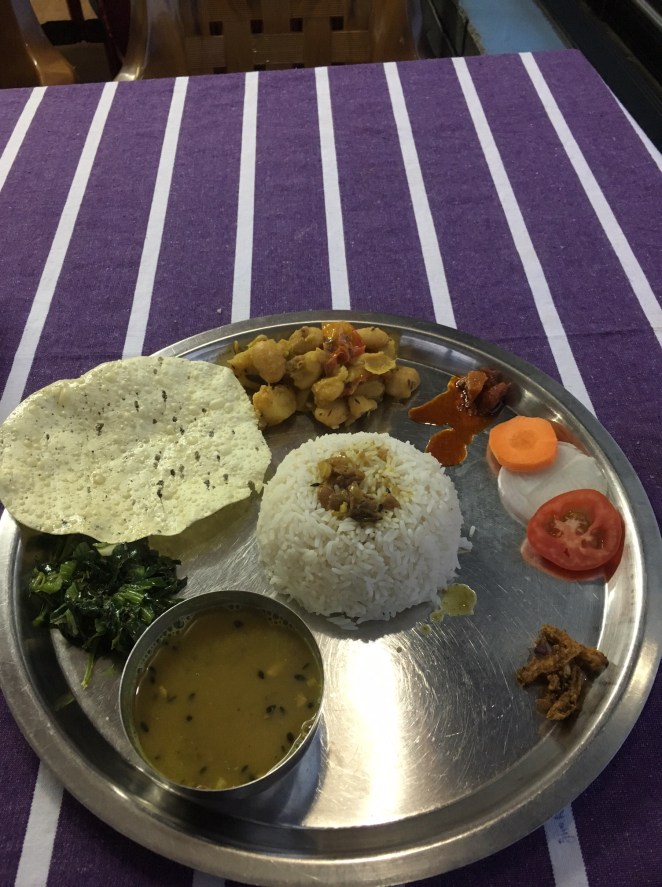
Day One brought us from Nayapul (1,050m) to Ulleri (1,960m), going from a lush, fertile valley up to higher elevation where Ulleri sits atop a giant rock formation. Along the way we crossed water buffaloes, porter donkeys, suspensions bridges, quaint mountain villages and, of course, we stopped every so often to take in sights of the bucolic Nepali mountainscape. The path to Ulleri was a difficult march upward, especially in the hot sun, as we gradually increased in altitude along more than 3,200 stone steps. While not extremely difficult for a fit 30-something, the trek is not for the weak-kneed or the faint of heart. I witnessed many older trekkers having difficulties regulating their breathing, which was probably worrisome to them since the road to ABC is a long one. Once we arrived in Ulleri, I settled in to a guest house, acquainted myself with fellow trekkers from different parts of the world, and savoured the first of many Dal Bhat, a traditional meal consisting of steamed rice and a thick lentil soup flavoured with onions, garlic, chillies, tomatoes, and tamarind. It was delicious and offers enough vegetable protein to keep me going, day in day out.
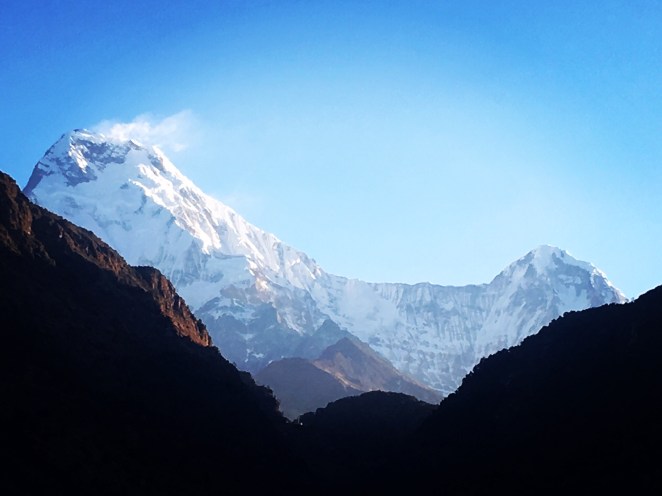
The following day started gloriously when I pulled the curtain from my window to revel in an amazing sight: the peak of Annapurna South drenched in the early morning light. To be sure, this is a sight that I will not forget. As I walked down, my Trek Dad, K.B., handed me a black coffee to help me emerge from the 6 a.m. haze. (What a guy. He’s always there catering to my every need. Also, he is so small and nimble that sometimes I don’t hear him sidle up to me. It was kind of creepy, in an endearing way).
Every day we followed the sun as we woke at dawn and settled into bed shortly after dusk after long days of hiking and climbing thousands of stone stairs. Usually the trekking takes place between 07:00 and 13:00, give or take a few hours. That said, Day Two brought me to Ghorepani (2,840m), a mountain village lying at the intersection of major trails linking the ABC area. The trek up to Ghorepani was really pleasant as I talked to several different people along the way, including Germans, Swedes, Americans, Brits, Danes, Chinese, Koreans, Thais, Malays, and more. My goal was simple: talk to everyone. That strategy really paid off during the afternoons and evenings as I frequently ran in to someone that I met along the road. For those who know me well, I am not at all shy about striking a conversation or bringing people together. I did that throughout my time on the road.


Only one word could describe Day Three: Epic. I woke at 4 a.m. to take on a 45-minute hike up to Poon Hill (3,200m) for sunrise (more stairs!) and I was richly rewarded with an incredible sunrise over three mountain peaks: Dhauligiri, Tukuche, and the mighty Annapurna. It was a really special feeling to see the sun gradually rise above a distant ridge to eventually cover the mountain ranges with fresh morning light. It was not exactly an intimate experience seeing as I was surrounded by more than 200 tourists, but it was personally meaningful for me as I stood there in awe of this surreal sight. It was the most beautiful thing that I have ever seen and filled me with a sense of peace and purpose.


After the magic show at Poon Hill we trekked up to Tadapani through densely forested areas and gorgeous valleys filled with grottoes, waterfalls, flocks of butterflies, monkeys, and majestic, tall trees. I won’t go into great detail about everything I have seen along the hike because this blog post grow to 3,000 words – not exactly a pleasant read. That said, I’ll fast-forward along the route to Machhapuchhere Base Camp (MBC), a high-altitude settlement sitting at 3,700m that serves as the gateway to ABC, our ultimate destination. The trek to MBC was gruelling, but I loved every minute of it. We slowly and gradually ascended to heavenly heights and we crossed a two-week old avalanche to get there. I was surrounded by sheer rock-face cliffs adorned with bands of wispy waterfalls. Again, always in awe of what I was seeing. We trudged up to MBC over five hours and the first thing I did was order a beer (obviously). Food and services get more expensive as you reach higher altitude, so that quenching beer cost me 860 Nepalese Rupees (about CAD$11). To put that in perspective, that same tall can would cost about 300-350 Rupees in a city. I split the beer with an Australian girl I met the night before and we sat there looking out to the mountain fortress surrounding us. That night, the trekkers all gathered in the dining hall because it was about -15 Celsius in the dorms (by the way, the accommodations are never heated at any point along the trek. Asking for a heavy blanket is key and K.B. was always there to hook me up). I ate yet another Dal Bhat, played cards with local Nepali guides, and chatted with a French couple living in Bangkok for work.


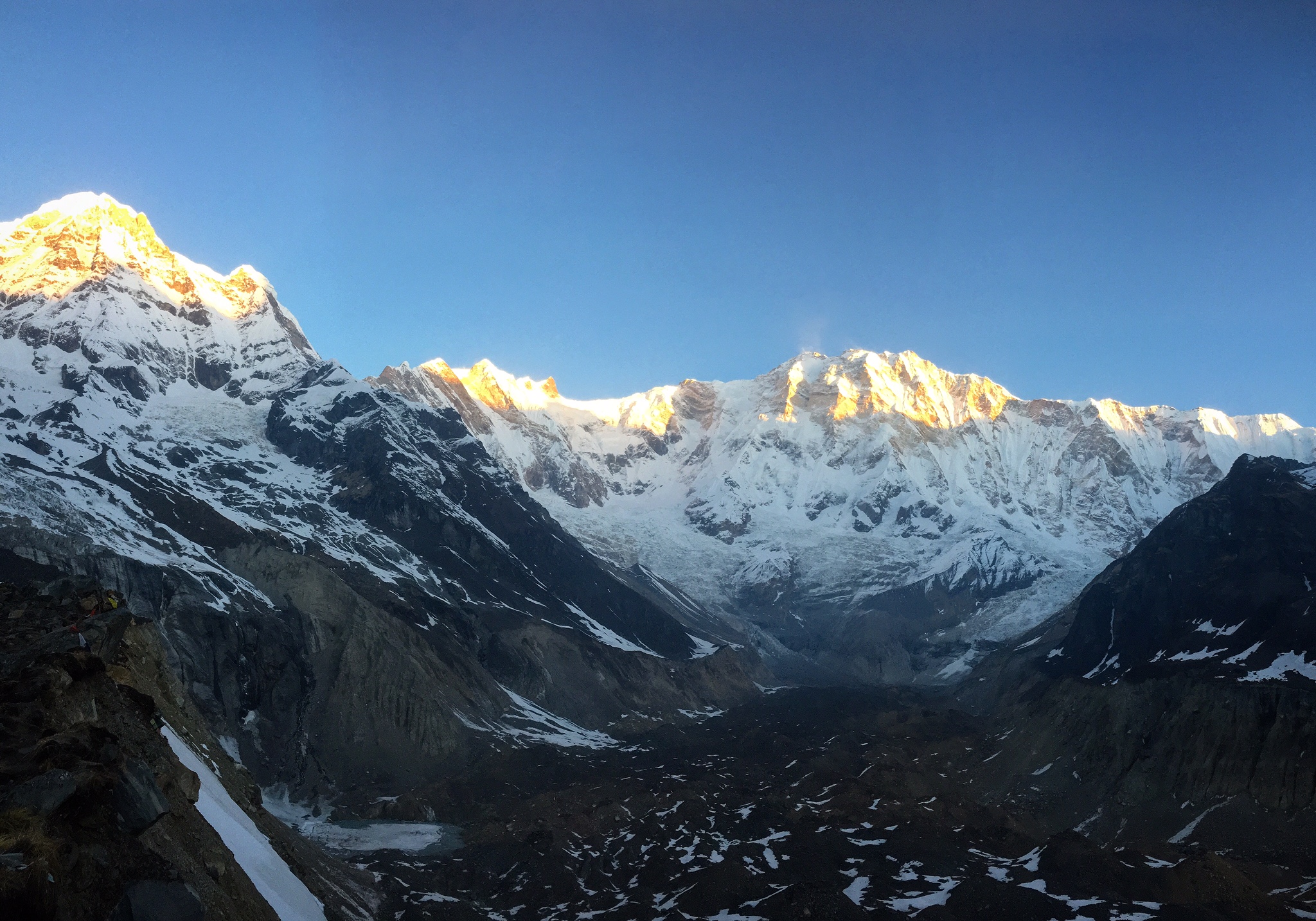
The morning of Day Seven started early at 4 a.m. to begin the two-hour trek up to ABC in the freezing cold. I felt determined to make it there well before dawn to get a good spot on ABC ridge in time for sunrise. So, I marched with purpose through the snow and led the way with K.B. far behind me. Again, it was a surreal experience to trek in the dark at 4,000+ metres in altitude, surrounded by some of the world’s tallest mountain peaks. Truly, it felt like I was in Earth’s Cathedral. I had a head lamp to see the “trail” (it’s all snow and ice), but I turned it off because the moon was bright enough to show me the way. I made it to ABC in 1h15m (apparently that’s impressive) and sat down on the ridge staring at the world’s tenth-highest mountain waiting for sunrise to hit the range.


I sat there, silent, thinking about what brought me here. If there is one thing I learned about Buddhism whilst touring the Tibetan refugee camp near Pokhara, it is that nothing in life is permanent. The wheel of life keeps turning and nothing is ever the same as we journey through time and space. Impermanence is a central tenet of Buddhism and it hit me hard because the series of unfortunate experiences that shook up my life recently have been brought on by change. Sitting there I realized that change is change – it is neither positive nor negative. It’s all just change. It is entirely normal to react negatively to change and resist it initially. In fact, it’s important to feel those emotions and appreciate the lessons that resistance to change teach us. However, it’s equally crucial to move past them once we have felt them and absorbed those lessons. I don’t know if it was the high altitude, but something within me changed that morning. I learned a valuable lesson that will hopefully stick with me throughout the rest of my days: impermanence and change are undeniable truths of our existence. The only real thing is the existing moment and, while it has been shaped by the past, it does not mean that it will be the same in the future. A person is what he/she is only in the context of the time in which he/she exists. I could learn a few things from being more transient and cherish the moment more for what it is instead of trying to make sense of the past. It seems an obvious lesson, but it’s hard to put into practice.
Okay, I got deep there for a second. Now, let me conclude this voluminous blog post. After ABC I experienced a HUGE day of trekking. We descended 1,700m over a 10-hour hike down to Lower Sinuwa and down/up yet more stone stairs. Suddenly, as we approached our destination, ominous black clouds filled the sky and it started to rain and hail like I have never seen before. But luck was on my side yet again — not only was it the sole rain day along my hike, I reached the guest house just as the torrential downpour began. The rest of the night I sat on a bench chatting with a Canadian and a Finn whilst we looked out to the endless valleys in front of us. It rained all night.

On our last day of the trek I headed to Jinhu, home to the hot springs. There was no better way to cap off a challenging high altitude mountain trek than sitting in natural, hot pools of mountain water with a cold beer. It was pure bliss and my aching muscles thanked me for it. At the pools I met a Swedish music producer and we have been hanging out ever since. Cool guy with a good outlook on life.

Now I’m back in beautiful Pokhara, sitting in one of the many coffee shops. I rented a room at a beautiful hilltop guest house overlooking Phewa Lake for only $10 a night! And it has a hammock on the front porch – score. I’ll probably sit in the hammock for a few days, reading, drinking beer, and going out for dinner with people that I met on the trek. The vacation continues and, yet again, I am SO glad I decided to travel the world for a bit as I reset my life. In a few days I’ll head to Chitwan National Park to experience the jungle safari. I’ll do the jungle walking tour, however, because I am opposed to elephant treks. In fact, that practice is reprehensible and should be stopped entirely. Anyways, I’m told I’ll see monkeys, rhinos, and other wildlife, maybe even Himalayan tigers. Don’t worry, I won’t get too close. I love life too much to lose it.
Oh yeah, I also went paragliding in Pokhara before leaving for the trek. Here are a few photos from Pokhara:


 Into the Breach
Bravo Mathieu pour ce voyage terrestre et le plus important le voyage intérieur….
Denise
LikeLike
Meanwhile, I’m reading this with tears streaming down my face! What a wonderful start to the rest of your life, loving and cherishing every precious moment. Thank you for sharing this with all of us!
LikeLike
Beautiful stuff here Matt. Looking forward to more musings.
LikeLike