
Whilst travelling in Nepal, the first stop on my months-long journey in Central and South Asia, the most frequently asked question amongst backpackers was, “Where to next?” Given Nepal’s geographic location, the most common answer was India or China. I, on the other hand, responded with Kyrgyzstan; an answer that elicited blank stares, confused looks or furrowed brows. Only two of the several dozen people that I met during my time in Nepal could point out Kyrgyzstan on a map, let alone be aware of the country’s existence. The “Stan” countries are often overlooked during the typical Asian backpacking route because you have to fly west to Central Asia, an expensive proposition for shoe-string backpackers, and also considering that the ex-Soviet countries are underappreciated relative to other countries in the Indian subcontinent or Southeast Asia. In my case, however, that is precisely why I wanted to travel to Central Asia. I wanted to get a first-hand look at the misunderstood former Soviet space, which is still very much within Russia’s sphere of influence.


I ventured to Kyrgyzstan (officially the Kyrgyz Republic) to see the country’s incredible natural beauty and learn about its proud nomadic traditions. Above all, I came here to visit a dear friend who has been living and working here for more than six years. In 2008-09, I attended a British postgraduate school of international relations based in Brussels, Belgium. During that time I forged a close, lifelong friendship with my flatmate John, an American student from Chicago. We both highly value that friendship and we have cultivated it over the years by staying in frequent contact and travelling with our international group of friends to various, far-flung destinations. Naturally, when the prospect of visiting John in Kyrgyzstan presented itself I jumped at the opportunity and booked a flight to Bishkek, the country’s capital, not knowing what to expect.
I landed in Bishkek on April 28th at 04:30 during a grey, rainy morning and queued up at customs surrounded by people who clearly were not backpacking tourists. In fact, I may have been the only backpacker on my flight from Dubai. To my surprise, the customs agent spoke no word of English and he could only offer a barely comprehensible “hello” as I handed him my Canadian passport. This was a harbinger for the coming weeks as only a very small minority of Kyrgyz people speak English. In Kyrgyzstan, Russian prevails as the lingua franca. Luckily, John dispatched his driver to pick me up at the arrivals gate and drive me to his apartment.
Bishkek is a larger, more developed city than I had imagined, especially compared to the still-developing, earthquake-affected country of Nepal. Uninspiring Soviet-era architecture is pervasive (though it does have some charm), but the city offers many green spaces, impressive statues and monuments, and postcard-worthy views of the snow-capped Ala-Too mountain range on the city’s outskirts. Like most Westerners, I erroneously thought of Central Asian states as derelict Soviet leftovers stuck in an uneven adjustment to post Cold War life. Indeed, Kyrgyzstan and its people are still adjusting to life as an independent state – though still pulled in to Russia’s strong gravitational pull – but there is important work being done to establish itself as a modern democracy amongst its orphaned peers in the region after the fall of the Soviet Union.


Russia brought economic development and modern infrastructure to Kyrgyzstan, a country that was once inhabited by nomadic, hunter-gatherer tribes. That, in part, explains why the Kyrgyz still hold Russia in high esteem and view it as a benevolent parent intent on seeing its child grow and evolve. Again, this defies the preconceived notions that we uphold in the West. Taking a political stance on Russia’s influence in the region is outside the scope of this blog post, but I will say that it was refreshing to get an unvarnished look at life in an ex-Soviet state.
Moving on to what I have actually done during my two weeks in Kyrgyzstan. As an American expat living in Bishkek, John quickly immersed me into the expat world and introduced me to intelligent, interesting people from around the world who call Bishkek their temporary home. Those connections wielded memorable conversations about international politics, culture and life in Central Asia and beyond. John also opened my eyes and stomach to new types of cooking that I had not been exposed to previously, although it was meat-heavy. Traditional Kyrgyz cuisine revolves around mutton, beef and horse meat, as well as dairy products, but the preparation is unique and very pleasant to the taste. I admit, however, that some of ingredients weren’t all that appealing, especially the frequent use of blubber from the rump of fat-tailed sheep. Indeed, the Kardashians of the sheep world. I was also introduced to Kurut, a popular snack. These pungent, dried yogurt balls were so intense that I had to permanently block the taste from my memory. Otherwise, the food was tremendous! Unfortunately I didn’t get a chance to try Kumis, a fermented dairy drink made from Mare’s milk. It was out of season because Mare’s have only begun giving birth to their foals in recent weeks.


During my first week I walked the streets of Bishkek during the day and went out for dinners with John during the evening. The most memorable Week 1 activity was participating in my first “hash”, a beer-fueled city race organized by the Hash House Harriers, an international club mainly comprised of expats. Members often describe their group as “a drinking club with a running problem,” indicating that the social element of an event is as important, if not more so, than any athleticism involved (click here to learn more about hashing). It was a great way to see the city, get some exercise (we ran about 10-12 km that day) and meet new people, all while building up a pretty serious buzz. Most runners/drinkers are not baptised and given their hashing name on their first hash, but I was fortunate enough to receive mine that day. I was dubbed “Pervistan” and anointed with flour and beer to make it official, as is the custom. The “perv” moniker was given because I broke a cardinal rule of hashing: no cameras during the hash. Luckily I snapped a few photos to share on this blog, and now I have a hash name for all forthcoming hashes.


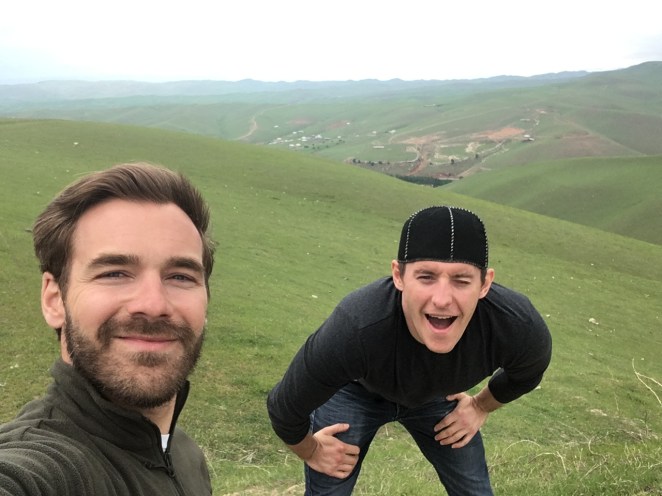
At the end of the first week a group of us flew to Osh, Kyrgyzstan’s second-largest city, to make our way down to Arslanbob for a weekend of hiking and sight-seeing. To get there we drove through the Fergana Valley, a densely populated inter-mountain depression spread across eastern Uzbekistan, southern Kyrgyzstan and northern Tajikistan. Usually dusty, dry and arid, rare spring showers transformed the valley into a fertile land of rolling green hills stretching in all directions towards distant, snowy mountains encircling the area. After a scenic drive across the valley, we arrived in Gumkana where we stayed in a guesthouse involved in Community Based Tourism (CBT), a national tourism initiative where tourists are hosted by local people in various rural regions across Kyrgyzstan to boost economic development and raise the profile of the country’s beautiful landscapes. My first CBT experience was fantastic and our host’s hospitality knew no bounds. During those three days we were exposed to a rich, local culture in a predominantly Uzbek and Tatar village, as well as amazing home cooked meals prepared by our host, Linara.
Arslanbob is home to the world’s oldest and largest walnut forest, and is also the site of the world’s first breed of apple trees. Jeremy, John’s friend, connected with us Bolot, a local man working for Fauna & Flora International, who guided us across the walnut forest and provided useful information and insight into the region’s rich ecosystem. Thankfully John is fluent in both Kyrgyz and Russian, making him an ideal translator. Bolot informed us that there are only 117 of the world’s first apple trees left and, as luck would have it, he has one growing in his backyard. We visited his homestead and got a close up look at the endangered tree species. Aside from trekking through the ancient Arslanbob walnut forest, we also hiked to 2,500+ metres to see an 80-metre tall waterfall. From that vantage point we were treated to awe-inspiring views of the Fergana Valley.


On our way back to Osh we visited Uzgen, an ancient trading post along the Silk Road connecting the Chinese Kashgar with the Fergana Valley. Home to a primarily Uzbek population, the city is perhaps most famous for its three 14th century mausoleums and a 44-metre high brick minaret. After the stop in Uzgen we arrived in Osh where we walked up to Suleiman-Too, a five-peaked rocky mountain situated in the middle of the city. The site has been a Muslim place of pilgrimage for centuries, supposedly because the Prophet Mohammed once prayed here. It was not an especially memorable sight, but it offered good views of the city and featured old caves and crevices reputed to have different curative or spiritual properties.


My time in Kyrgyzstan exceeded my expectation because, well, they were pretty low to begin with. I would highly encourage backpackers to venture out to this overlooked Central Asian country to get a glimpse of a somewhat closed-in culture that is not very well understood by most people. Kyrgyzstan has a lot to offer in terms of sheer natural beauty and the country’s people are just as welcoming as other tourist hot spots. However, that said, I should mention that the welcoming attitude is not as prevalent in Bishkek where English-speaking foreigners are often regarded with suspicion.
John treated me to an unforgettable time in his adopted home and I am extremely appreciative of his boundless hospitality and generosity. My time here once again proved that staying in touch with international friends is absolutely worth the effort, and I have no doubt at all that this friendship will continue to blossom as we grow old and continue busting our knees and livers through more hashing (see paragraph 7 above regarding the hash).
Up next: one week in Georgia, a gorgeous country in the Caucasus region of Eurasia where I will visit Tbilisi (the capital city), Batumi on the Black Sea coast, and Kazgebi in the north where a 14th century monastery is perched atop a mountain at an elevation of 2,170 metres. In addition, I’ll try to throw in a wine tour seeing as Georgia is one of the oldest wine regions in the world.
Pervistan, out.
 Into the Breach